Bolivia's Governance Crisis Under Rodrigo Paz
During the past two months, the centrist pro-U.S. Bolivian government of Rodrigo Paz Pereira has been navigating a minefield of social discontent, institutional dilemmas, and criminal forces and partners seeking to destabilize his government. He will likely survive the current struggle but could be forced to resign before the end of 2026 as a product of political and economic pressure from those effectively besieging the Bolivian capital. In the future, as in the now-dissipating crisis of May–June 2026, a spiral of violence and other destabilizing dynamics could push Paz out if he tries to use the military to respond to those confronting his government. His resignation could have grave implications for security and democracy among Bolivia’s South American neighbors. Although the outcome is central to the success of the Trump administration’s approach in the Western Hemisphere, it is generally off the radar for most of Washington.
From May 20 through May 30, 2026, as the political and security crisis was unfolding, the author was in Bolivia interviewing senior political, business, and government officials. This report contains the author’s insights regarding the conditions, dilemmas, and dynamics playing out in the country and what the coming months could hold.
Background
Paz and his government are a tapestry of complexity and contradiction. Paz was born in Spain to a Spanish mother. Both his father, Jaime Paz Zamora, and his grandfather, Víctor Paz Estenssoro, were presidents of Bolivia. His political background is one of the “caviar left,” combining the heritage of his father’s role as founder of Bolivia’s Revolutionary Left Movement (MIR) and his own substantial education and professional experience in the U.S. financial sector. That orientation and the heterogeneous group of people it brought to power as his cabinet ministers and circle of advisers play an important role in the current crisis and the decisions he is making.
Paz is an “accidental president” who came to power as the descendant of a line of presidents. Yet he also brought a contemplative, intellectual tradition that, in the perception of some consulted for this study, has inhibited him from taking decisive action in defining the course of his new government and managing the present crisis.
After 20 years of rule by the populist left Movement Toward Socialism (MAS) party, widespread corruption, and an economic crisis that highlighted profound MAS mismanagement, Bolivian voters were ready for something new. Meanwhile, infighting between MAS founder and cocalero (coca grower) union leader Evo Morales; his successor, Luis Arce; and Andrónico Rodríguez, the young cocalero leader who might have inherited the MAS mantle, effectively destroyed the party in the months leading up to the August 2025 election.
While the MAS effectively removed itself from the stage after almost 20 years running the country, many in Bolivia’s principally Quechua- and Aymara-speaking Indigenous communities in Altiplano (the western highlands) looked with distrust toward long-standing, right-oriented politicians such as Jorge “Tuto” Quiroga, Samuel Doria Medina, and Manfred Reyes Villa. That distrust deepened during the transitional November 2019–November 2020 administration of Jeanine Áñez, whom Indigenous and other marginalized groups in the Altiplano saw as going too far. According to this view, Áñez attempted too quickly to reorient Bolivia’s policies and foreign policy alignment with a right-oriented agenda following the 2019 ouster of President Morales, a leftist populist cocalero.
In the August 2025 presidential election, Paz, accompanied by traditional right-wing running mate Sebastián Careaga, was receiving little traction in the polls until Careaga abandoned the candidacy, obligating Paz to replace him with tough-talking fired police officer Edmand Lara. Although the prior criminal accusations against Lara had been well substantiated according to those consulted for this study, Lara’s macho style and strong anticorruption rhetoric connected well with voters looking for an alternative to both the discredited MAS and traditional right elites. Lara’s style was discordant with, yet oddly complemented, Paz’s centrist, inclusive posture. Paz famously campaigned across the Andean highlands on a motorcycle, visiting countless small, mostly Aymara communities, promising to identify with and respect such people. The credibility of Paz’s commitment was bolstered by his father’s leftist MIR credentials. His message was further magnified by an innovative social media campaign, leveraging apps such as TikTok, widely used among the people of the highlands. The innovative social media campaign that propelled Paz to the top was also, importantly, pioneered by Paz’s daughter Catalina and her Argentine former professor Fernando Cerimedo.
The question of who or what was responsible for Paz’s unexpected victory in the October 2025 second round of Bolivia’s elections later took on outsize importance, with President Paz publicly crediting his daughter’s social media campaign. According to those consulted for this analysis, she may have contributed to his substantial confidence in Cerimedo and the substantial influence Cerimedo was seen to have in his administration.
The other influences on President Paz have reportedly been a complex and evolving mix. They include his brother Jaime Paz Pereira, who comes from the Andean Development Corporation (CAF) and has reportedly helped the government secure commitments for lines of credit from the CAF and other organizations. They also include Mauricio Zamora, his relative from Tarija; old-guard MIR members tied with his father, such as interior minister Marco “Tuco” Oviedo and Óscar Eid Franco; former Presidential Secretary Doria Medina; and vice presidential candidate José Luis Lupo.
With respect to Vice President Lara, the relationship quickly soured, beginning with accusations by Lara that the president had not provided adequate places for his family members at the inauguration. According to many consulted for this study, Lara, who saw his role in the victory as decisive, became increasingly embittered toward Paz over not receiving the amount of influence, respect, and associated ministerial positions he thought he deserved after the role he played in Paz’s victory. Lara increasingly became a political opponent of President Paz rather than part of the government.
The Path to the Current Crisis
Arguably, Paz inherited the conditions driving the current crisis from his predecessors. Nevertheless, individuals consulted for this analysis generally see him as moving slowly to implement new economic and security policies that address these challenges and communicate the direction of his government. Twenty years of neglecting to invest in the natural gas sector, the country’s primary source of hard currency, and other policies that discouraged investment under Morales and Arce fed the progressive decline in production and associated generation of dollars. This situation led to problems for importers, shortages of imported goods, inflation, and social unrest, which only compounded the problem.
In the first months of the Paz administration, the problems that had contributed to the ouster of the MAS and its disappearance as a political party led to an escalating series of demands, which Bolivia’s financial and fiscal situation made almost impossible for the new administration to address. These included demands from teachers and other sectors for salary increases to cover inflation, as well as demands for fuel subsidies due to dramatic increases in the prices of gasoline, diesel, heating oil, and cooking gas due to the war in Iran. In particular, these affected the 80 percent of Bolivians working in the informal sector.
If the Paz administration was slow in putting new policies in place to address problems from previous administrations, the crisis of unmeetable demands was compounded by his perceived shift away from campaign rhetoric that courted marginalized communities toward cabinet choices, policies, actions, and discourse that led marginalized communities who had supported him to feel left out and even betrayed. Many of those who felt disillusioned had previously supported the MAS but voted for Paz and Lara as the perceived least worst choice compared to more traditional right-oriented politicians.
Compounding this growing disillusionment, Paz named a cabinet with a relatively technocratic orientation, including politicians from Doria Medina’s National Unity Party. Unlike the Morales and Arce cabinets, Paz’s cabinet had relatively few Indigenous faces or representatives of leftist unions and social movements. Symbolically, Paz departed from Morales’s practice of consulting Indigenous union leaders, miners, and others of the former MAS coalition and bringing them into the presidential palace.
In the eyes of such groups, Paz spent too much time courting the economic elites of the Media Luna lowland instead of the groups of people underpinning their power.
Compounding the problem, some of Paz’s early laws—such as Law 157, concerning land reclassification—while economically logical, were not well communicated, particularly not to marginalized Indigenous communities in their primary tongues, such as Quechua and Aymara. Moreover, Paz’s opponents on the left, such as Morales, arguably used their closer connections to these groups to represent Paz’s policies in the most negative and threatening form. In the eyes of such groups, Paz spent too much time courting the economic elites of the Media Luna lowland instead of the groups of people underpinning their power.
As Paz was losing ground with the marginalized groups he once successfully courted, he also experienced early difficulties with his right-oriented rival Quiroga and his Libre party. Before Paz’s rise, Quiroga had been leading in the polls and had some expectation that Paz would reach out to him to form a coalition government. When Paz instead formed an alliance with the candidate who came in third, Doria Medina, and brought some of Doria Medina’s people into his cabinet, including Lupo as minister of the presidency, Quiroga and Libre effectively became the opposition, albeit one with a vested interest in not seeing Morales return.
The Emergence of the Current Crisis
A defining moment in the current crisis occurred when the Paz government imported a batch of poor-quality gasoline that damaged the motors of cars, trucks, and motorcycles across the country. Although Paz responded, those with damaged vehicles did not see him going far enough in terms of either compensation or holding those responsible accountable.
The response was also symbolic of a larger perceived problem with Paz’s government. The questionable gasoline contract had been made by the prior leftist government under Arce, but Paz’s government did not move fast enough to identify and root out the socialist predecessor’s bad contracts. Such inaction fit into a broader series of perceptions that the Paz administration was slow to act, both in advancing and implementing its plans and in rooting out problematic people tied to Arce who might be foot-dragging, sabotaging, or misrepresenting his agenda.
Beyond issues of implementation, at the beginning of his administration, Paz was relatively ineffective in communicating his policies, reasoning, and vision for the country in the face of discontent. By April 2026, he had brought on presidential spokesperson José Luis Gálvez Vera. Gálvez’s representations of government policy reduced the emphasis on Paz alone for policies that caused discontent but did not fundamentally overcome the negative perceptions of Paz among parts of the population.
Road Blockades, Destabilization, and Morales’s Role
As such policy and style choices compounded discontent over the economic crisis, a core force led by former leftist populist President Morales sought to bring down Paz’s government. As head of the federation of coca growers of Chapare, Morales’s home territory, Morales has long been associated with individuals linked to narco-trafficking activities. The coca grown in Chapare is transformed there and elsewhere into cocaine. Then, with the help of international narco-trafficking groups such as the First Capital Command and Red Command of Brazil, the cocaine is smuggled east through Brazil, Argentina, and Paraguay and west through Peru and Chile to markets principally in Europe and Oceania.
Drawing on substantial resources, some allegedly linked to narco-trafficking, Morales has been looking for a route to return to power. That search took on much greater urgency when the Paz government invited the U.S. Drug Enforcement Agency back into the country, cautiously opening doors to security cooperation with the United States, and began working to reform security institutions to control Bolivia’s illicit cocaine production.
As discontent grew in Bolivia, Morales has played a key protagonist role in turning protest over legitimate grievances into destabilization.
Morales’s bid to oust Paz became particularly urgent when the president brought pedophilia charges against Morales for having sexual relationships with and impregnating a 14-year-old girl, Gabriela Zapata. Morales did not show up for a court date to answer the charges and has been holed up since that time in Chapare, defended by his core supporters.
As discontent grew in Bolivia, Morales has played a key protagonist role in turning protest over legitimate grievances into destabilization. Frustration over bad gasoline, high prices, and a Paz administration law to facilitate commercial credit for land ownership led opponents to form road blockades as a time-honored, if economically disruptive, form of protest. Those consulted in Bolivia for this analysis, however, see Morales as playing a key role in expanding, sustaining, and radicalizing the protests, motivated by a desire to prevent the police from arresting him in Chapare and eventually overturn the government and return to political power. As such, Morales has mobilized thousands of supporters and has funded the blockades, greatly expanding and sustaining them by feeding and paying supporters. Reciprocally, social control organizations tied to Morales’s network reportedly have intimidated or fined those in neighborhoods who did not support the blockades or protests.
Cocalero money has arguably increased the number of people at blockades and their access to instruments of violence, such as arms and dynamite, used to respond to the police and create the feel of an armed insurrection. This dynamic has reinforced the sense that any intervention by authorities could lead to significant bloodshed, which is, according to numerous senior Bolivian political and business leaders interviewed by the author off the record for this project, exactly what radicals seek to facilitate the fall of the government.
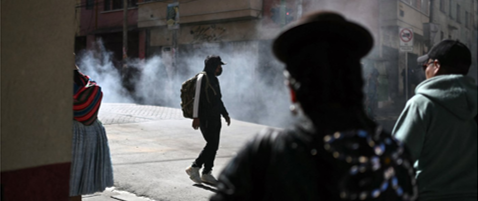
By the end of May 2026, after a month of blockades, police were reporting over 80 individual cuts in routes across six of nine departments in the country, with the majority concentrated in La Paz in the Altiplano. The geography of the city allowed closing a relatively small number of roads to cut off the movement of food, gasoline, and other supplies into the city. In La Paz, the blockades caused serious issues of hunger, hospitals running out of oxygen, patients dying because ambulances could not reach medical facilities, and a shortage of fuel for transport, cooking, and heating, among other problems. In the lowlands of the department of Santa Cruz, a smaller number of blockades in areas with concentrations of Morales followers, such as on roads near San Julian and Yapacani, threatened to cut the city off from productive areas in the east and markets in the west, though the road to Tarija in the south and the route to Brazil to the southeast remained unobstructed.
The blockades, while they were in effect, created an extremely difficult dilemma for Paz, increasing discontent with his leadership on both the right and the left. Rather than pursue early confrontation that could escalate violence, he has sought to wait out the protesters and achieve partial agreements with different groups. He has, for example, repealed the land reform law, agreed to increase teacher salaries, and made certain concessions to miners, though such gestures have pacified only portions of the groups and, arguably, have emboldened others. Key radicalized protest groups such as the Bolivian Workers’ Central syndicate and the Tupac Katari federation have remained in the streets, ambiguous even in their intention to negotiate with the administration. Paz has even sought the help of leftist Brazilian President Luiz Inácio Lula da Silva, owing to his reported ties to Morales.
Security Force Vulnerabilities
Paz’s initial modest attempts to use the police to clear the roadblocks in early June went poorly. In part, this is because the government is not merely confronting spontaneous expressions of protests but armed persons, military tactics, and violence. An attempt to open a “humanitarian corridor” to allow medical oxygen and other life-sustaining supplies into La Paz, personally led by the minister of public works and close Paz confidant Mauricio Zamora, for example, was ambushed and forced to retreat. In the confusion, the minister was separated from the convoy and, for a time, was evading opponents seeking to capture and possibly kill him. Indeed, in an incident in the same area years earlier, a different minister had been ambushed and killed by protesters. Further, during the present crisis, a column of Bolivian police seeking to open up the road from Santa Cruz to Cochabamba was ambushed by opponents throwing dynamite from carefully selected elevated positions, again forcing the police to retreat.
Beyond the liability of military and political leaders for such actions, the president has reason to worry that things could get out of control in a large-scale deployment of security forces.
With the support of allied forces in Congress, Paz eliminated a MAS-era law that restricted military deployments under a “state of siege,” but he has been reluctant to invoke such a state and deploy the military to remove the roadblocks. His hesitance is not, however, without reason. During previous military deployments against protesters in 2003 and 2019, civilians were killed, and military and political leaders involved in the action were ultimately jailed or forced into exile abroad. That legacy was brought up in virtually every conversation the author had about military intervention.
Beyond the liability of military and political leaders for such actions, the president has reason to worry that things could get out of control in a large-scale deployment of security forces. Both the national police and the military lack adequate equipment for deployments that bring them into contact with protesters, such as rubber bullets, tear gas, and protective gear. Moreover, a significant portion of the personnel from both the military and police come from the same marginalized communities that security forces might have to act against.
Many of the officers in both the police and military owe their careers to the Equal Opportunities Plan, a special initiative established by the Morales government in 2008 to allow persons without formal education to become officers. Many of these came from Chapare, the center of the current resistance to Paz. Today, many officers who obtained their commission and rose through the ranks under the program are now majors, lieutenant colonels, or colonels and occupy important command positions. Moreover, many military personnel have attended programs in Cuba for ideological indoctrination during previous MAS governments or have participated in the “anti-imperialist school” that the Cuban government helped Morales to set up in Bolivia. Thus, while Bolivian security personnel are responsible professionals, there are risks of conflicting loyalties that could lead some to refuse to act, join the protesters, or engage in actions that deliberately escalate the situation for the purpose of sabotage.
Pressure on the Paz Government
In the face of deepening suffering and adverse economic consequences, there was, and continues to be, growing frustration in Bolivia with the lack of decisive action by the Paz government. During the author’s stay in Santa Cruz, the city’s well-organized civic committee and youth league (UJC) were frustrated with the government for not dismantling the blockades, which caused economic damage to the department, and were on the verge of going to San Julian to dismantle the blockade themselves. In anticipation of the arrival of the Cruceños (citizens of Santa Cruz), antigovernment leaders sent thousands of their people to the site, many reportedly well armed. Only the intervention of Catholic Church leaders and a last-minute decision by the Pro–Santa Cruz Committee—the dominant organization in the department bringing together social, business, and community organizations—to temporarily call off the action prevented what would likely have been a bloody confrontation.
Many consulted for this study believed that Morales and his supporters deliberately sought to provoke violence to further their agenda of forcing political change. The Bolivian constitution has no provision for the democratic removal of a president short of a recall referendum in the second portion of the president’s term, which for Paz just began. Morales and his supporters may be calculating that fostering a sufficient level of violence, political paralysis, and economic damage will force Paz’s resignation. Morales has already called, unconstitutionally, for new elections within 90 days as the solution to the crisis.
Under the Bolivian constitution, if Paz resigns, as President Gonzalo Sánchez de Lozada did in 2003, power would pass to the vice president. Although many interviewed for this analysis believe Lara would welcome the opportunity to be president, even if only briefly, they argue that Morales’s objective is not to install Lara as president but, rather, force a sequence of events similar to the 2003 resignation of the vice president and head of the Senate, making the head of the Chamber of Deputies, Roberto Castro Salazar, president temporarily but obliging him to call for elections in 90 days.
Several individuals consulted for this study further argued that some political leaders on the right might be open to such a scenario because, while they are wary of any political chaos that could bring Morales to power, new early elections could create an opportunity for them to capture the presidency. For the Paz government to prevent such scenarios without a risky military crackdown, those interviewed by the author spoke of two interrelated groups of options: (1) co-opting the “non-Morales” opposition and (2) bringing Morales to justice for narco-terrorism, presumably by extraditing him to the United States or another country with a valid legal claim for extradition.
Although Morales and his cocalero allies from the Chapare are arguably the principal financiers and protagonists behind the blockades and protests, other leftist opposition groups and unions, even radical ones, have a long-term interest in Morales’s departure. This is because his dominance denies them leadership and influence within the Bolivian left. At the same time, Morales’s alleged ties to narco-trafficking taint and legally endanger their organizations through association. Co-optation, however, would probably require expanded outreach by Paz to opposition groups to address their monetary and policy demands and even to bring them into the Paz government through cabinet positions. Such a strategy, however, could backfire as it requires money and political power that Paz may not have. It would also likely increase the backlash to Paz among his allies on the right, further decrease the coherence and effectiveness of his government, damage its already disastrous fiscal balance, and discourage badly needed foreign investment and finance.
Strategic Options and the U.S. Role
According to some interviewees, juridically designating the leadership (not membership) of Morales’s cocalero federation as a narco-terrorist organization, capturing Morales, and extraditing him to the United States could open the door to more fruitful engagement between Paz and opposition groups around their legitimate grievances. Bolivia’s national police are arguably too underequipped and compromised to be used in such an operation. Although the Bolivian military has a number of capable units that could be employed, including the Diablos Rojos, Diablos Verdes, and Diablos Azules, U.S. support would likely be necessary in the form of a coordinated operation authorized by Paz. Any such cooperation would make it paramount to identify and address questions of corruption or other problems in the units involved in the operation, as well as at higher levels.
If the United States were to play a role in capturing Morales, formalizing criminal charges against him and other cocalero leaders for their alleged narco-terrorism activities would provide it with more authorities and tools for doing so, as well as more political cover for the Paz administration in acting. Prior to any action, the United States should consider designating the leadership of the cocalero union as a terrorist organization, as it recently did with the First Capital Command and Red Command, complementing its prior designation of more than 18 entities in Mexico, Colombia, Venezuela, Central America, and elsewhere. Doing so would strengthen the juridical basis and options for any U.S. support for action against Morales or other narco leaders in the framework of Bolivia’s membership in the Americas Counter Cartel Coalition and Shield of the Americas.
While some suggested that arresting and extraditing Morales and other cocalero leaders on narco-terrorism charges could be politically explosive, the vast majority of those consulted for this analysis felt that, as long as there is a sound legal basis and clear public charges and Morales is not left in a Bolivian jail, things would calm down in the country. Following such an operation, however, it would be imperative for Paz to meaningfully engage with the non-cocalero Indigenous opposition and other groups that feel excluded. Interviewees also noted it would be prudent for the United States to follow up any kinetic operation against Morales with activities that provide military, economic, and social benefit to Bolivia as a pro–U.S. business and security partner. This might include investments facilitated through the U.S. International Development Finance Corporation and U.S. Export-Import Bank in sectors such as lithium, rare earth materials, petroleum, and infrastructure.
For Bolivia, the United States, and the region, the risks of failure are significant.
As a complement to material support, a constructive U.S. role would be strengthened by a U.S. Senate–confirmed ambassador in Bolivia. Although the United States has a highly capable embassy team in the country, the symbolism of a confirmed ambassador with close ties to President Trump would arguably bolster perceptions that the White House is invested in the success and survival of a democratic pro-U.S. government in Bolivia that has narco-terrorism and other criminal dynamics under control.
For Bolivia, the United States, and the region, the risks of failure are significant. Most of those consulted for this study felt that Paz would probably survive the current crisis, with or without U.S. help, though he might be greatly weakened. The dissipation of the crisis during the end of June 2026 seemed to prove that analysis correct. Those consulted were less optimistic, however, that he will survive the year if he does not address the fundamental challenge posed by Morales and political vulnerabilities in his relationships on both the right and left, as well as show progress on key economic and other issues through decisive leadership and associated communication.
The pro-U.S. Paz government is a member of President Trump’s Shield of the Americas initiative. Its fall and Morales’s return to power would thus be a significant symbolic setback to President Trump’s agenda. The impact of that setback would be even greater since Morales is a cocalero with well-established ties to Cuba, Iran, China, and Russia. His restoration would be a symbolic defeat for the current U.S. administration’s efforts to counter Cuba’s regional subversion and communist governance, as well as to reduce Iranian, Chinese, Russian, and other malign influence in the region.
Paz’s fall and Morales’s triumph in Bolivia would also likely have spillover effects far beyond the country. Criminal networks linked to Bolivian cocaine exports already extend into the west of Brazil, Paraguay, and the north of Argentina, including through narco flights and the presence of criminal representatives from those countries. One visible example is recently captured Uruguayan narco kingpin Sebastián Marset, who lived in Las Palmas, one of Santa Cruz’s most exclusive neighborhoods. A Bolivia that evolves from a troubled host of narco-trafficking activities to a full-blown narco state and sanctuary for criminal groups would undermine democratic governance, prosperity, and U.S. influence in the region, and open the country up to expanded influence by China and other malign actors, as has already occurred in the past.
The good news is that Bolivia has a president and leadership who know the United States well from past professional and diplomatic engagement and are disposed to work with it. U.S. support to help the Paz regime survive and thrive would provide an important narrative complementing the positive aspects of what the United States has achieved in Venezuela and what it has begun to build with its Shield of the Americas and other initiatives. For the Trump administration, it is a critical opportunity to show others in the region and beyond the value proposition of working with the United States.