China's Limited Advance in El Salvador
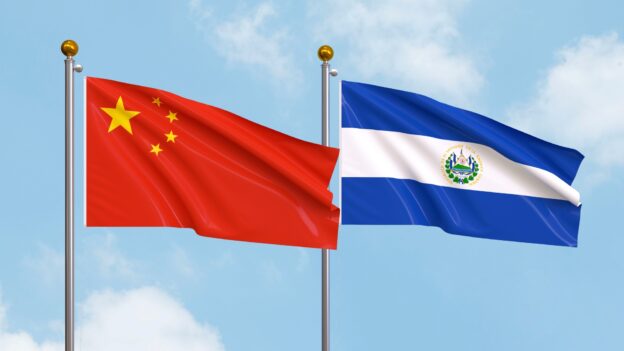
In the context of El Salvador’s transformation under Bukele, its relationship with China continues to be both limited and contradictory.
El Salvador has undergone an impressive, yet dystopian, transformation under President Nayib Bukele. Just a few years ago, the historical district was a gang-ridden labyrinth of crumbling structures and dirty market stalls. It is now a glistening tourist mecca of safe pedestrian streets, posh shops and restaurants, and whitewashed civic buildings. At its center is a massive Chinese-built public library, a sprawling glass structure, illuminated at night like a Christmas tree, overshadowing the adjacent Presidential Palace.
During June 2026, the author was in El Salvador, as a guest of the Salvadorian Industry Association (ASI). This article is based on his conversations there with Salvadoran businesspeople regarding China and supporting research.
An array of China-built structures, officially gifted to El Salvador during Bukele’s December 2019 visit to China, symbolize the “new” El Salvador that the president’s effective yet controversial security and other policies have enabled. They include the $54 million library, which reportedly receives 100 tourists and diners in its library-top restaurant for every student seeking books. Chinese gifts also include a tourist pier with high-end beachfront dining at La Libertad, which opened in November 2024 as part of Bukele’s “Surf City” tourism project.
Just blocks from the U.S. Embassy in San Salvador, China State Construction and Engineering (CSCE) is building a massive 50,000-person stadium. It is also doing preliminary work for a new convention center nearby. The project has engendered resistance since it involves paving over a portion of the “El Espinal” forested park, one of the city’s few large green spaces. Chinese companies are also completing a major water treatment facility at Lake Ilopango, which was announced in 2019 but subject to numerous delays.
Although the symbolism of these gifts is powerful, the transformation of El Salvador has arguably occurred in spite of, not because of, the country’s deepening engagement with China. Bukele’s pro-business orientation, public-private sector coordination, and a dramatic reduction of crime and insecurity has re-opened the country for tourism, investment, and other economic activity, including 80 major construction projects. Curiously, China-based companies have invested almost nothing in this boom.
Indeed, the Chinese commercial relationship with El Salvador is increasingly lopsided. In 2024, the country exported a mere $50 million to China, mostly sugar, while importing $3.57 billion from it.
In April 2024, the Bukele government publicly launched negotiations for a free trade agreement, although persons close to the government told the author it has been quietly set aside.
At the retail level, the penetration of Chinese products is notable. Stores concentrating in Chinese merchandise like China Depot, Banda, and Hiper Asia are ubiquitous in the capital, including in iconic locations like Ruben Dario Street and the Boulevard of the Army.
Most Chinese products are imported by local businesspeople. The Unicomer Group, of Salvadoran Mario Siman, for example, is a major importer of Chinese electronics. Locally owned Energy Motors imports BYD and other Chinese car brands, while Zhejiang-based CFMoto is a major importer of Chinese motorcycles.
Beyond retail and work on donated construction projects, the Chinese business presence in El Salvador has been limited.
In the pharmaceutical sector, following vaccine donations during the COVID-19 pandemic, China-based Sinopharm tried unsuccessfully to establish a foothold in the country.
In the electricity sector, China-based giant PowerChina is working on a modest 30 megawatt solar energy project at Conchagua, in an area where the Bukele government began building a new international airport in February 2025, as part of its plans to transform the area into a new development hub. While there are suspicions that a China-based company like CSCE may be selected to build the airport – which is being funded by a $386 million loan from the Andean Development Corporation (CAF) – information about the selection is being closely guarded.
This is the same area where, years prior, Chinese-Salvadoran businessman Bo Yang surreptitiously acquired Perico Island, near the Port of La Union, leading to concern that the entire area was being earmarked for a Chinese megaproject.
The trade imbalance arguably also reflects a lack of government infrastructure and networks to support successful sales to the Chinese market. El Salvador’s former trade promotion organization, PROESA, and its replacement, INVEST, reportedly lack resources and contacts in China. The country has struggled to establish a compelling national brand identity that would induce Chinese to pay a premium for perishable Salvadoran agricultural products shipped from halfway around the world.
By contrast to many other countries in the region, there is no El Salvador-China Chamber of Commerce. China’s own commercial promotion organization, CCPIT, has been active in El Salvador since 2010, but facilitates Salvadoran imports of Chinese products more than China purchases of Salvadoran ones.
El Salvador’s commercial frustrations with China have not stopped Salvadorans from dreaming. The Confucius Institute, established in October 2019 at the University of El Salvador (UES), has an impressively large program for a small country. The Chinese government initiative provides language and cultural instruction by teachers from China. Reportedly, 4,500 students have gone through the program since its founding, with 300 enrolled in the 2026 academic year alone. China awards approximately 35 scholarships per year to Salvadorans for academic study in China. A former UES student noted that, despite the difficulty of the language, there is more interest in learning Mandarin than English.
Beyond language, although there are no degree programs in El Salvador for China studies, there is growing interest. In November 2024, during a trip to China, the former dean of UES Juan Rosa Quintanilla held discussions with the China Academy of Social Sciences (CASS) about developing China-oriented course materials at UES.
As with other countries in the region, China also continues to engage with El Salvador at the political level. China’s ambassador to the country, Zhang Yanghui is reportedly very active in networking among Salvadoran associations, and speaks fluent Spanish.
In April 2024, a delegation of congresspersons of Bukele’s New Ideas Party, led by Vice President Felix Ulloa, traveled to China. Mayor of San Salvador Mario Duran, also with the New Ideas Party, has also traveled to China, supported by a 2019 MOU on Beijing-San Salvador friendly cooperative exchanges. China has brought numerous Salvadoran journalists to China, particularly from the pro-government newspaper Diario de El Salvador.
Despite such political engagement, Bukele has notably avoided substantial security cooperation with China, possibly reflecting a desire to maintain good relations with Washington.
In short, in the context of El Salvador’s impressive transformation, its relationship with China continues to be both limited and contradictory. The Bukele government, and Salvadoran businesses, continue to wrestle with how to better pursue commerce with China, while protecting themselves from the consequences.