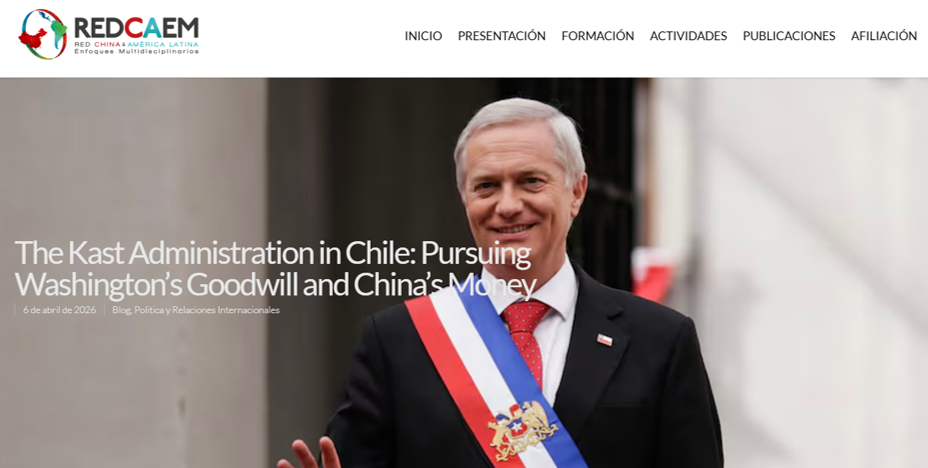
From March 22-28, 2026, I was in Santiago Chile, giving presentations and speaking to experts on the activities of the People’s Republic of China (PRC) in Chile. The country’s new President Jose Antonio Kast, inaugurated on March 11, is navigating a delicate path between his priority to strengthen relations with Washington, and the enormous leverage that the PRC has over Chile as the country’s principal export destination, with broad and deep business and personal relationships throughout the country. Symbolic of the dilemma, Chile’s Chicago-educated Foreign Minister, Francisco Perez MacKenna, hails from a business background with close ties to U.S. companies and the American Chamber of Commerce, yet previously occupying the number two position in the Luksic Group, one of the most powerful business organizations in Chile, whose mining and other businesses are dominated by their ties to the PRC as a client and a partner. In his public discourse, including an interview on the new administration’s foreign relations posture with leading newspaper El Mercurio, Perez MacKenna has taken painstaking steps to avoid suggesting that President Kast’s notable embrace of Washington on key foreign policy and other issues implies a Chilean willingness to cool its ties with Beijing. Indeed, during my week in Chile, Perez McKenna’s social media account posted a message broadly discussed among those with whom I interacted, with side-by-side pictures of the Minister shaking hands with both U.S. Ambassador Brandon Judd and PRC Ambassador Niu Qingbao, identical down to Perez MacKenna’s body posture, suit and tie.
In the weeks surrounding the installation of President Kast and his government, multiple symbolic events showcased U.S. efforts to push back against PRC activities in strategically sensitive areas in Chile, and PRC actions to assert its persistent presence and show it would not be cowed. The U.S. sanctioned three top officials of the outgoing Gabriel Boric administration for their role in a Chinese fiber optic data cable between Valparaiso and Hong Kong, which would potentially have given the Chinese intelligence access to a significant portion of data routed between the two continents, with PRC Ambassador Niu striking back, that China would not allow the U.S. to “undermine the sovereignty” of other countries. Even as the drama of the “Chile-China Express” data cable played out, a Chinese oceanography ship, the Tan Suo Yi Hao, accused by Australian security experts of engagement in espionage activities, conducted a mission represented as scientific exploration in Chilean waters. Almost simultaneously, the People’s Liberation Army Hospital Ship Silk Road Ark made calls in the Chilean ports of Antofagasta and Valparaiso, despite an arguable lack of need for such “assistance” in Chile’s high-quality healthcare system. Indeed, they were not authorized by the Chilean government to conduct medical operations under the country’s strict medical quality control laws. Not long before these incidents, the Chilean government had also put a halt to PRC construction of the Ventarrones space facility in the Atacama Desert, in which experts had identified a risk of being used for military purposes against the U.S. in time of war.
During my own address inaugurating the academic year at Chile’s National War College (ANEPE), a three-person PLA delegation, including their military attaché, Senior Coronel Wang Hui and his deputy, Lieutenant Coronel Chen Chen, attended the session along with a number of other military attaches of countries friends of Chile, although colleagues told me that it is rare for them to appear in such fora.
While the most public U.S. pushback regarding China’s activities in Chile have involved the military, space, and strategic technology domains, the most important PRC levers over Chile are arguably its deeply entrenched position as a business partner, complimented by the webs of relationships it has built in the country. As one senior Chilean businessman with whom I spoke frankly put it, with 40% of Chile’s exports going to China, twice as much as what Chile sells to the US, the country would be foolish to risk provoking China. He cited how the PRC had imposed sharp economic sanctions on Australia when the later had pushed back against China on security issues, illustrating to me that the PRC record of subtle but significant vengeance against those who defy it is very much on the mind of Chileans.
Virtually every major sector of the Chilean economy is touched by the PRC in some way. 75% of Chilean copper, the country’s major export, and a similar portion of its lithium, goes to the PRC. China’s Tianqi is an important investor in Chile’s lithium sector, in partnership with SQM, connected to Chilean business magnate Julio Ponce Lerou. China also purchases 90% of Chile’s cherries, and a significant portion of its grapes and other fruit, well as Chilean wine, and even wood pulp.
In the electricity sector, PRC-based companies control almost 60% of electricity distribution throughout the country, and are the dominant vendors of solar panels, as well as important builders of wind and solar facilities throughout the country. 40% of autos in Chile are Chinese, with Chinese companies such as BYD having a far bigger share of the electric vehicle market, including electric busses. As examples, all busses in Coipaipo are now electric, sold to the city by China, while Santiago has the largest fleet of Chinese electric busses outside the PRC.
In telecommunications and other digital industries, PRC-based companies are dominant. Chinese cellphone brands including Huawei, ZTE, Xiaomi, Honor, and Oppo, are ubiquitous, offered through almost all of Chile’s major service providers, Movistar, Entel, Claro and WOM. Huawei has at least three data centers in Chile, and had announced plans to build more, along with China’s Tencent, if the previously mentioned Chile-China Express cable goes forward.
In the strategic port sector, two Chinese companies, China Railway Construction Corporation (CRCC) and China Harbour Engineering Corporation (CHEC) are among seven pre-qualified for the first phase of a long-delayed but important project to expand the Port of San Antonio, Chile’s most important deepwater port, serving the greater Santiago metropolitan area. Of less commercial value, but of potentially enormous strategic importance, during my trip, colleagues also made me aware of initial signed commitments for a new port project by Shanghai Ports Investment Corporation in Tierra del Fuego, where a Chinese facility could potentially give the PRC opportunities to observe and even put at risk the transits of U.S. warships through the Straits of Magellan and the Drake Passage in time of war.
CRCC has also played key roles in major infrastructure projects involving improvements to Highway 5, the major Noth-South artery in the country, and Line 7 of the Santiago Metro, although CRRC ran into performance problems with both projects that led the Chilean government to remove them from the metro project, as a well as a $140 million lawsuit on their Highway 5 work.
In the retail sector, there are an estimated 1,000 “Chinese Malls” throughout the country, in virtually every Chilean city. They have become the focus of authorities due to improper practices from carrying contraband goods to practices such as not issuing receipts, that allow them to avoid paying taxes.
Ironically, in sectors such as electricity, mining, and transportation infrastructure, the market-friendly, regulation-streamlining policies that President Kast supports, could actually accelerate the advance of PRC-based companies in the country, especially those whose projects were stymied by environmental and other regulations during the prior Boric administration.
Beyond just business, the Chinese networks that have emerged in Chile through business and other ties are also notable. These include formal organizations like the China-Chile Business Council (CHICIT). Chile’s Congress has an unusually large PRC friendship group, with over 40 members in the prior session, including its head, Chilean Communist Party member Karol Cariola, who was implicated in an influence trafficking scandal involving Chinese businessman Emilio Yang and the improper certification of one of his Chinese Malls. Such networks also involve trips for local officials, sometimes leveraging the “Sister City” and “Sister Province” relationships the PRC has established in the country, such as that between Hefei and Santiago.
In academia, major Chilean universities such as the University of Chile, Catholic University, Saint Thomas, and Andres Bello have Chinese studies programs sustaining networks of scholars with academic ties to the PRC. Initiatives linking China-focused Chilean scholars across multiple universities, such as the Nucleo Millenium ICLAC program, further facilities such ties. Beyond such academic networks, the PRC has 17 Confucius Institutes in Chile including one in the Catholic University, one in the Frontier University in Temuco, a new one, opened in December 2025, at the University of the Magallanes, and a total of 14 associated with campuses of Saint Thomas University across the country. Chile also hosts CRICAL, the headquarters for all Chinese Confucius Institutes, at Saint Thomas University. These institutions also serve as a key gateway for attracting Chileans interested in Chinese language and cultural studies, channeling the most capable towards deeper contacts with the PRC through Chinese government-funded and other scholarships.
In the media space, both of Chile’s leading national papers, El Mercurio and La Tercera, receive advertising revenue from the PRC. El Mercurio regularly publishes verbatim editorials submitted by the PRC Ambassador, Niu Qingbao. The left-oriented Radio Cooperativo, and the PRC organization Radio China International, co-produce a relatively well-known pro-China program, “The China Effect.”
PRC networks in Chile extend to criminal activity, with the strongest presence believed to involve a mafia group based in Fujian. They are reportedly involved in human trafficking, growing marijuana and synthetic drugs, among other activities. There is anecdotal evidence that Chinese intelligence services may work with such groups. A suspected PRC “police station” in Viña del Mar, for example, was located in a restaurant, Fooly, owned by Chinese businessman Wang Ing La, with suspected mafia ties.
With so many China ties among Chilean business groups, and so many webs of Chinese “People-to-People” relationships, it is difficult to imagine the Kast government significantly reducing the PRC commercial presence or reducing its pushing back on the PRC politically. It is equally likely that the U.S. Ambassador to Chile, Judd, known for his directness, will continue to call out risky or improper engagements with the Chinese. Meanwhile, President Kast will continue to walk a delicate path regarding how much to rein in his own government team, possibly risking PRC economic and other retribution, in order to further strengthen the relationship with Washington.