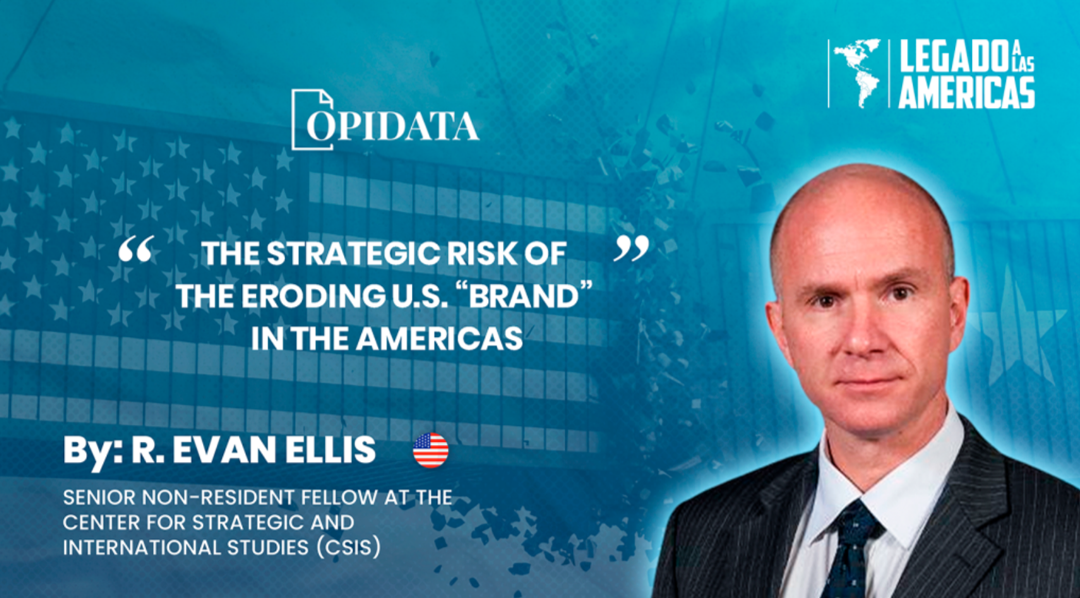
The Strategic Risk of the Eroding U.S. ‘Brand’ in the Americas
An analysis of how regional perceptions of the United States are changing in light of China’s strategic and symbolic advances in Latin America.
Strategic competition between the United States and China is not only being fought in the economic and military arenas, but also on the symbolic and cultural fronts. A recent regional study reveals a significant deterioration in the perception of the United States across Latin America.
THE IMPORTANCE OF NATIONAL “BRAND”
From designer goods to restaurant chains, to law firms and other service companies, business leaders understand the value of their “brand,” and spend billions of dollars and enormous effort to protect and promote it. They understand that the well-being of their company is based in part on how customers “feel” about their product, and how embracing it, over the alternatives, makes them feel about themselves. Business leaders comprehend that, to varying degrees, associating with their product and firm is not just a cold calculation, but an emotional choice. Perceived “bad behavior” by the business, even polemical statements by CEO, can kill sales. Reciprocally, spending on “doing good”–even if it does little actual good—is not necessarily wasted if it can effectively position the brand.
Just as business leaders must consider–but also see beyond–raw dollar transactions, political leaders must consider military and economic might, yet also respect how national power and interests are rooted in the country’s brand, including the networks of institutions, alliances, and trust that sustain it. It is ironic that what generations of graduate students and practitioners defend as “realism,” is based on valuing only a tiny portion what constitutes actual power and influence in the international system. It is similarly ironic that the term “pragmatism” is used by some to defend policies that risk squandering the long-term bases of national power and security, in order to secure short-term benefits for a subset of the polity.
“67% consider China to be the best partner in digital technologies, compared with 19% who choose the United States.”
CHINA’S RISING POSITION IN REGIONAL PERCEPTION
A recently-published large and credible opinion survey of 12,000 people in 10 Latin American countries, “AMLAT Radar,” documents a substantial, multi-dimensional decline in the U.S. “brand” in the region, vis-à-vis its strategic competitors such as China.
36% of respondents identify the PRC as the best development model for their country. The U.S., which has fallen 13 percentage points since the last time the survey was done in 2022, does not even finish second, but rather, third, behind Japan.
Of even greater concern are the responses on which country would be the best partner for their own in specific areas. On trade, 49% see China as the best partner, versus 26% choosing the U.S. On digital technologies, 67% see China as the best partner, versus a mere 19% for the U.S. In culture and education, an astounding 40% chose China, while only 18% incline toward the cradle of hot dogs, apple pie and rock-and-roll.
AMLAT RADAR AND THE DECLINE OF THE U.S. IMAGE
The new AMLAT Radar data also illustrates how the new tone, policies and actions of the U.S. government during 2025, have shaped perceptions and impacted the U.S. brand. Across the 12,000 people surveyed, respondents see the policies of the current U.S. Administration as 28% more negative than positive.
While the U.S. is still seen as a leader in some areas, what respondents now identify it with is, versus China, is also worrisome from the perspective of their respective brands. Among the 12,000 surveyed, 54% see the U.S. as a global leader in military power, and 49% on “counterterrorism,” both areas emphasized in actions and statements from Panama to Canada to Greenland to Venezuela to Iran. China, by contrast, is identified by 75% of respondents as a global leader in technology development and by 63% in Artificial Intelligence, versus 12% and 20% for the U.S., once regarded as the unquestioned standard in such fields. Even if the respondent’s perceptions are misaligned with reality, they are a problem if the U.S. expects that countries in the region will refrain from working with the PRC in these areas, due to the presumably overwhelming lure of access to the U.S in those domains.
COERCION, TRANSACTIONALISM, AND LOSS OF INFLUENCE
The U.S. is far from losing its deeply entrenched economic, cultural, and military position in Latin America. The region’s embrace of the PRC as a model and a partner certainly reflects a limited understanding among those polled of its risks as an often-predatory commercial partner, or of China’s system, which sacrifices the individual rights and protections cherished in Latin America, for the promise of economic development, technological efficiency, and order.
Still, the AMLAT Radar results should be an alarm bell for U.S. policymakers, some of whom presume that historic U.S. military, economic and technological dominance means that it can apply its leverage, take actions, and reduce incentives to align and cooperate with the U.S. without consequence. Recent U.S. emphasis on coercion and transactionalism in pursuit of its interests, rhetoric which is sometimes disrespectful of the region and its people, and policies incurring costs on U.S. neighbors, which increasingly feel more imposed than agreed, are hurting the U.S. brand and opening doors for its adversaries such as China. U.S. reductions of programs to address educational, medical and social needs in the region, to protect individual rights, and strengthen its institutions, and to communicate the importance of democracy and the U.S. as a source for good, is arguably not helping matters.
THE STRATEGIC CHALLENGE FOR WASHINGTON
As effective businessmen know, true “realism” requires considering all factors which are critical to the wellbeing of the company, and true “pragmatism” is the difficult, if not-always-sexy work to invest in the fundamentals of the firm, its brand, and its relationships to preserve its long-term viability. The same logic applies to effective stewardship of the U.S. national interest. It involves a pragmatic, realist, balanced embrace of democracy, empowerment of the individual, free markets, rule-of-law, and national power. In a very different Washington D.C. not so many years ago, such endangered ideas were once called “conservative.”