APEC 2026 and the Advance of China's Long Game
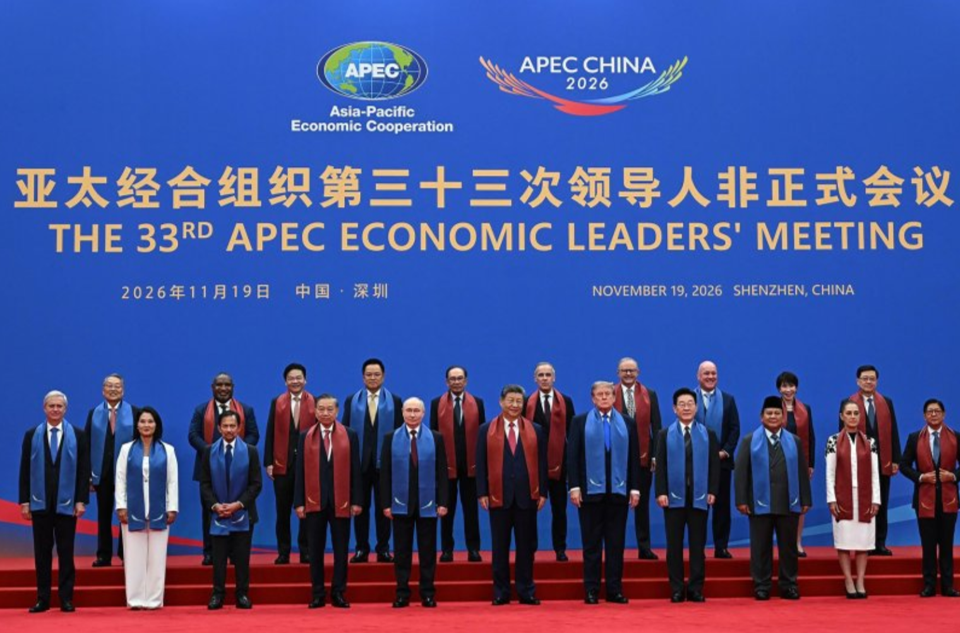
Nov. 25 (UPI) -- The most strategically consequential outcome of the Asia-Pacific Economic Cooperation leaders' summit in Shenzhen was not the meeting among U.S. President Donald Trump, Russian President Vladimir Putin, and Chinese President Xi Jinping on the sidelines, but rather China's advancement of its long game through both the summit itself and Xi's bilateral meetings, including with Mexico's Claudia Sheinbaum, Chile's José Antonio Kast, and Peru's Keiko Fujimori.
APEC highlights a worrisome dynamic. Washington focuses on symbolic meetings with authoritarian leaders, tariffs on and threats against longstanding allies, and lethal strikes against adversaries ranging from Iran and the Houthis to narcoterrorists. Meanwhile, China is quietly restructuring the global strategic environment in its favor, weaving webs of relationships, interests, and influence with U.S. partners.
Although the Trump-Putin-Xi summit was symbolically important, it accomplished relatively little and offered limited prospects for concrete follow-up, given each leader's domestic situation. Among the points of agreement, the recognition of the dangers of nuclear weapons and their proliferation to additional states is positive.
Yet China arguably has little incentive to restrict its weapons production while it is in the middle of a buildup, and Putin has little incentive to do so while he is at war with Ukraine. He has regularly used the threat of nuclear escalation to deter NATO partners from a more aggressive military posture.
Similarly, the leaders' shared interest in increasing production of refined petroleum products is aspirational. It will likely depend on Putin's ability to reduce the vulnerability of Russian petroleum infrastructure to Ukrainian long-range strikes. It will also depend on whether the Trump administration can overcome Iranian efforts to control the Strait of Hormuz.
The leaders' shared interest in restricting the International Criminal Court's authority is nothing new; it reflects a broader weakening of the international institutions and rule of law that have sustained the global order, however imperfectly, since the Second World War. That erosion ultimately disadvantages the U.S. and the West, to the benefit of authoritarian states such as Russia and China.
Largely ignored in Washington, APEC itself allowed its Chinese host to advance its strategic objectives: developing alternatives to the U.S.-dominated global financial system and positioning itself for leadership in artificial intelligence and robotics, which are key to military, economic, and political supremacy in the emerging global order.
At the summit, the leaders present, ironically including the U.S. president, welcomed the voluntary, nonbinding APEC Trade Digitalization Cooperation Framework (2027-2030), covering everything from paperless trade and customs modernization to cross-border e-commerce.
Although the framework does not address settlement currencies, China could use the resulting digital infrastructure and interoperability to advance its broader efforts to develop alternatives to dollar-centered financial channels.
Similarly, Shenzhen advanced implementation of the APEC Artificial Intelligence Initiative (2026-2030), adopted the previous year in Gyeongju. This included cooperation on developing AI-related technologies and addressing issues ranging from safety to workforce training.
The agreement indirectly facilitates the diffusion of Chinese open-weight models, AI systems that anyone can download and run. They are attractive because users in developing countries can adopt them without licensing costs and adapt them to local needs.
It also advances the normalization of China as a responsible steward of AI, despite serious concerns about potentially inadequate safety testing of its models and the risk that its customizable open-weight models can be more readily adapted by malevolent actors to develop cyberweapons and bioweapons.
A 2025 NIST evaluation found DeepSeek's models far easier to jailbreak than U.S. models.
Xi's sideline meetings were notable. Claudia Sheinbaum sought to rebalance and diversify Mexico's trade with China but ended up committing to potentially compromising exchanges of scientists and scholars in areas such as artificial intelligence and biotechnology.
Peru's U.S.-friendly Keiko Fujimori doubled down on the port of Chancay as the centerpiece of a logistics bridge between China and South America. The port is run by the People's Liberation Army (PLA)-affiliated logistics giant COSCO, which the Pentagon lists as a Chinese military company.
During her visit, she also opened the door to "cooperation" with China on artificial intelligence and further Chinese penetration of sectors ranging from electricity production and transmission to electric vehicles and mining. China will also fund a $22 million command center, modeled on one in Shenzhen, to monitor public safety.
With respect to Chile, Xi invited U.S.-friendly President Kast to China for an official visit and pressed for expanded cooperation in sensitive areas such as AI, activities in the Antarctic, and undersea exploration (potentially facilitating operations by PLA submarines in the future), as well as mining, investment in electricity, and other infrastructure.
Perhaps most notably, Xi and Canadian Prime Minister Mark Carney committed to a further reduction in trade barriers, opening possibilities for PRC-based companies to offset constraints on Canada's commercial relationship with the U.S.
They pledged to increase cooperation in AI governance, e-commerce, technology, energy, and financial services, and to launch a Canada-China CEO Roundtable.
Even more worrisome, the leaders announced Canadian-funded scholarships for 850 Canadian students to study in the PRC. This opens the door to relationships of influence and potential compromise by the PRC of Canada's future leaders.
To put these advances in perspective, President Trump also had an eventful week in Asia. At a "Quad" summit with India, Japan, and Australia, he advanced cooperation on maritime surveillance, artificial intelligence, and disaster response.
With Thailand, he advanced a trade agreement and a possible $123 million HIMARS purchase, and with the Philippines, a possible $12 billion Boeing 787 purchase, a $2 billion defense financing package, and improved military access to Basco Airport, near Taiwan.
Still, while the U.S. touts the historic nature of the Trump-Putin-Xi summit and possible deals for U.S. companies and the military, it would be wise to note China's quiet advances in e-commerce, AI, and ties with U.S. allies, particularly through scientific cooperation, personnel exchanges, and the technologies that will open doors to digital access and define strategic advantage.