China’s 2025 White Paper on Latin America Sets the Stage for Renewed Competition With the US

The new document declared China’s intention to expand its influence on all fronts, even as the U.S. is turning its focus to the Western Hemisphere.
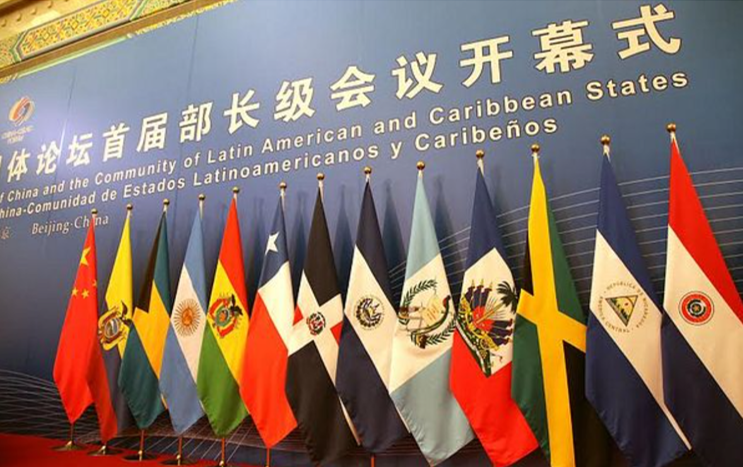
On December 10, China released a new white paper on its relationship with Latin America and the Caribbean. The latest version, following China-Latin America white papers in 2008 and 2016, maintained the established interval of eight or nine years between updates.
The document is self-confident, albeit diplomatic, in tone, detailing China’s commitment to continuing the broadening and deepening of its relationship with Latin America and the Caribbean on all fronts.It highlighted China’s expanding activities with the region not only in commerce and investment, but also in science, technology, and people-to-people exchanges; national, subnational, and multilateral political engagement; and growing engagement in strategic sectors including military, police, space, digital technologies and artificial intelligence.
The timing was notable: the document was released just days after the new U.S. National Security Strategy, which focused heavily on pushing back against China’s influence and encroachment in security and other strategic sectors in the Western Hemisphere. Nonetheless, China’s white paper made no direct references to the United States as part of the hemisphere, or increasing U.S. resistance to China’s advances. It featured only indirect references, such as a comment in the opening about “unilateral bullying” in the region, Latin America’s “glorious tradition of independence,” and China’s willingness to coordinate with “third parties” in its relationship.
The document was predictably broader and more detailed than the 2016 white paper. The 2025 version covered an expanded list of areas of cooperation, forums and other engagement mechanisms, and technical issues, from free trade agreements to investment protection and dual taxation to customs inspection and quarantine. The new scope reflects the growth and maturation of the relationship in the nine years since the last white paper was written.
In its key areas, the document followed the format adopted in the China-CELAC 2025-2027 plan, organizing itself around five “programs” of cooperation: “Solidarity,” “Development,” “Civilization,” “Peace,” and “People-to-People Connectivity.” In parallel, the white paper reaffirmed Latin America’s role in each of its five “initiatives” organizing its global engagement: the Global Governance Initiative (GGI), Global Development Initiative (GDI), Global Civilization Initiative (GCI), Global Security Initiative (GSI), and “Belt and Road cooperation” (the latter being a subtle downgrade from Beijing’s use elsewhere of the term “Belt and Road Initiative”).
China notably begins its discussion of engagement with Latin America with governance issues, not commerce. In the framework of its Global Governance Initiative, Beijing proclaimed its intention to work with Latin America to “reform” multilateral financial institutions. Among those it mentioned by name are the International Monetary Fund (IMF) and World Bank, the G-20 and APEC, and BRICS, where China has led the establishment of the New Development Bank.
Seeking to leverage discontent with new U.S. tariffs and other policies toward the region, China positioned itself as the champion of the “open and cooperative international environment,” standing in opposition to “bullying” and “decoupling,” presumably by the United States.
In the commercial domain, beyond predictable references to mutually beneficial trade relationships and a myriad of fora and entities to promote it, the document highlighted China’s interest in promoting transactions in local currencies, rather than the dollar, with “swaps” and other mechanisms to facilitate it. The white paper also mentioned a range of financing mechanisms, including “panda bonds,” for funding China’s projects in Latin America.
China’s new white paper specifically mentioned oil and gas (not just green energy), as well as infrastructure projects (including electricity and telecommunications infrastructure), manufacturing, and agriculture as areas where Beijing will continue its focus in Latin America, naming multiple China-CELAC subforums to facilitate that engagement.
Also within the “Development” section of the document, China highlights its intention to deepen cooperation with the region in various strategic areas likely to attract the concern of Washington. These include technology transfer and “exchanges” of scientists, as well as artificial intelligence and space cooperation. The white paper professes an intention to promote the region’s reliance on China’s BeiDou satellite system (a competitor to the Western Global Positioning System), raising data vulnerability and other issues.
The document also committed to involving Latin American personnel in China’s manned space programs. Notably, however, this discussion ignored controversial Chinese access to space observation and tracking facilities in the hemisphere. China’s Deep Space Radar facility in Neuquen, the China-Argentine Radio Telescope, and the Ventarrones observatory in Chile are not mentioned.
The development section discussed a role for Beijing in “regional fisheries governance,” possibly reflecting negative attention to illegal fishing activities by the Chinese deepwater fleet. It also mentioned China’s intention to engage on environmental issues, another area where the track record of China-based companies in the region is problematic.
By contrast to the United States’ move away from “climate change,” the white paper talked extensively about China’s engagement with Latin America on climate issues. This is an area where China-based companies are making significant advances with electric vehicles (EVs) and renewable energy generation, while the U.S. has arguably ceded the space in international forums. The document further noted Beijing’s intent to advance cooperation on disaster response and the vulnerabilities of “small island states,” such as those in the Caribbean, a strategic maritime space for the U.S. where China has a growing commercial, political and security sector presence.
With respect to China’s “Global Security Initiative,” the white paper notably dedicated an entire extended section to security collaboration, which China calls its “Peace Program.” Although prior documents have mentioned China’s security-related activities in the region, the new version went much further, lending its blessing to expanding military training, exchanges, and activities in the region, including those involving police and judicial personnel. It built on statements of intent in the 2025-2027 China-CELAC plan by committing to expand law enforcement engagement with the region. The document specifically mentioned planned activities in anti-corruption, money laundering, and cyber crime.
In the “Peace” section, the document takes subtle swipes at the United States, declaring China’s opposition to “cyber-hegemony,” presumably referring to U.S. attempts to exclude Chinese companies and components from Latin America’s digital infrastructure. It also declared its support for the region as a “zone of peace,” likely a reference to U.S. military operations in the Caribbean. The new U.S. National Security Strategy declared an intention to expand the U.S. military presence there, which will be used for lethal attacks against alleged drug cartels “where necessary.”
Finally, the white paper section on “People-to-People” exchanges represents a stepped-up effort to expand China’s soft power – and possibly complement its opportunities for espionage – in the region. On one hand, China committed to expanded support for poverty reduction, social development, and health in the region. On the other hand, the white paper included the goal to increase China’s “subnational level” exchanges. That will arguably proliferate options for Beijing to woo mayors and other local officials below the radar of national scrutiny and national government rules against cooperating with foreign governments.
Historically, China’s policy white papers have been good roadmaps for predicting Beijing’s areas of focus in engaging with the region. The present document declared China’s intention to proceed forward confidently on all fronts, including in sensitive infrastructure, technological sectors, military and space, and people-to-people engagement (with the resulting opportunities for influence and espionage). The white paper outlined this plan without deference to or even acknowledgement of U.S. sensitives, likely putting China on a collision course with the United States in the region in the months and years ahead.