Ueno Bank scandal: Corruption, stability and Paraguay's importance
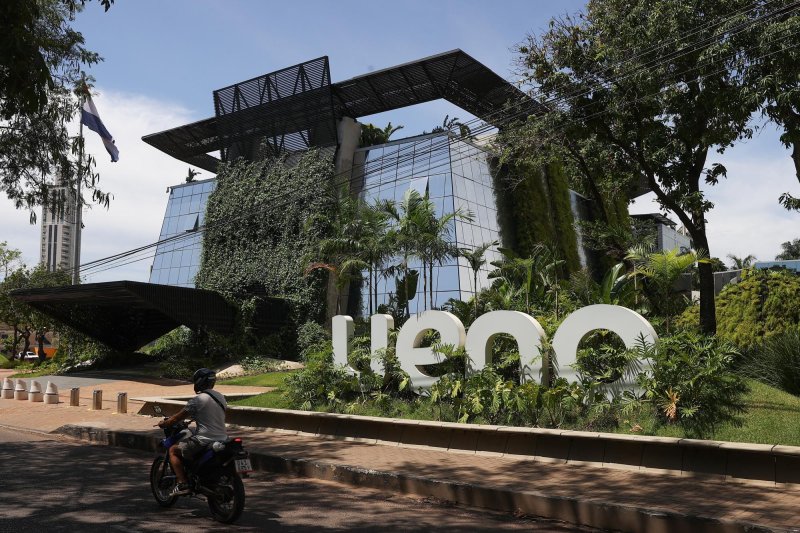
Nov. 13 (UPI) -- The crisis at Ueno Bank in Paraguay this month, and the removal and arrest of the country's president, Santiago Peña, are a tragedy for the country, with implications and lessons on multiple levels for the country and the region.
First, it has caused grave short-term economic hardship to Paraguayans. The bank reported 2.9 million customers, and 9% of the portfolio of Paraguay's Social Security Institute (IPS) was held there.
In a series of moves surprising for their scope and rapidity, Peña was removed from office on Nov. 6 by a unanimous Senate vote, including members of his own Colorado Party, then put into pretrial detention for his alleged role in the collapse of the bank. He denies wrongdoing.
In parallel, Central Bank President Carlos Carvallo also resigned and now faces criminal prosecution. Ueno's president, Juan Manuel Gustale Cardoni, and its first vice president, Federico Miguel Vázquez Villasanti, have both been detained and charged.
Paraguay ranks 150th out of 182 countries in the Transparency International Corruption Perceptions Index. The core alleged reason for the Ueno crisis was excessive high-risk lending by the bank for projects connected to its owners, with efforts to conceal the bank's increasingly perilous condition on its balance sheet, and regulators overlooking warning signs, possibly tied to Carvallo's role as previous President of the Bank (although Carvallo claims he formally recused himself from Ueno-related decisions).
At a second level, widespread corruption in many countries of the region can also be used as an instrument of political warfare, even if what happened in the present case is unclear. In the months prior to the scandal, President Peña increasingly sought to build bases of support independent of his political patron and mentor, former president Horacio Cartes.
Cartes publicly backed the removal of Peña over the bank scandal. Some Paraguayan commentators suggest that the move against the bank itself may have been a countermove against Peña removing protection from Cartes-aligned politicians, as Cartes reconsolidates his own power within the Colorado Party.
The good news is that the financial, commercial and political damage to Paraguay is not as grave as the magnitude of the scandal suggests. Some 97% of depositors were fully covered by deposit insurance, although only about 30 percent of deposit value was insured. By Nov. 10, $330 million had been paid to 1.74 million depositors.
Moody's has evaluated the economic effect of the crisis as "manageable," with no immediate impact on Paraguay's sovereign credit profile. Vice President Pedro Alliana succeeded to the presidency on Nov. 6 through constitutional processes and without challenge. He has appointed a well-respected new head of the Central Bank, Jorge Schreiner. Legal processes against those accused have proceeded according to established norms, despite their high-level political connections.
There is also, at present, no indication of political fallout that would jeopardize Paraguay's recognition of Taiwan, which is strategically vital to the United States and the region.
Although the Ueno crisis highlights defects within Paraguay's institutions and socially conservative, "clubby" political culture which need to be addressed, its handling also highlights the country's strength, resilience and strategic importance.
Paraguay's ability to deal with a banking crisis affecting nearly half its population reflects its longstanding political and economic stability and pro-business environment, compared with the political oscillations and periodic crises of some of its neighbors.
That stable, pro-business environment, plus other factors such as low labor costs and relatively abundant clean energy from its Itaipú and Yacyretá hydroelectric facilities, have helped position Paraguay as an emerging South American hub for data centers and other projects.
Paraguay's geography, including its central location along South America's Paraguay and Paraná rivers and access to the Atlantic Ocean, as well as the new Capricorn Bioceanic transport corridor, also makes it strategically important to regional commerce.
Its importance is magnified as an original MERCOSUR member, and as South America's last, and the world's largest by area, state still diplomatically recognizing Taiwan. Paraguay's role as a longstanding U.S. ally will also grow in importance as its neighbor Brazil likely turns increasingly left, putting Brazil on a collision course with Washington during Luiz Inácio "Lula" da Silva's next presidential term.
Policymakers in Washington should give greater attention to Paraguay's strategic importance and longstanding role as a stable, democratic friend of the United States.
Yet as the new Democratic-controlled Congress takes office in January 2027, the conservative roots of Paraguay's demonstrated stability and resilience could become a liability.
Cartes' apparent reconsolidation of power within the Colorado Party after the Ueno scandal, to the extent Paraguay makes it onto Washington's "radar," could prejudice the country in the eyes of some Democrats who remember Cartes' alleged links to narcotraffickers and even the terrorist group Hezbollah.
That the Trump administration removed corruption sanctions imposed on Cartes under Global Magnitsky Act authorities, just as it pardoned former President Juan Orlando Hernández in Honduras, could make Paraguay a target rather than a positive news story, as the incoming Congress scrutinizes the Trump administration's foreign policy.
The speed with which Paraguay has weathered the Ueno crisis is a testament to the character of the Paraguayan system.
Yet with a new Congress coming to Washington, the haste with which President Peña and others implicated in the Ueno scandal have been removed, with a disquieting sense of "nothing to look at here folks, keep on moving..." and the question of "who benefits" from the unusually swift application of democratic process and justice, may mean that the matter is not yet quite over.