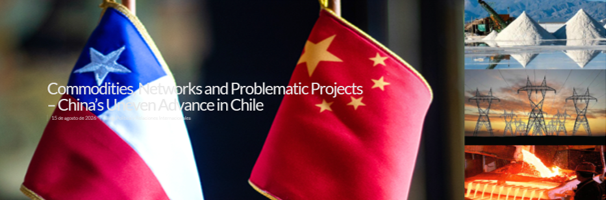
U.S. sanctions against then Chilean Minister of Communications and Transport Juan Carlos Munoz for non-transparent contracting to award a transpacific data cable to a China Mobile-led consortium highlighted strategic sensitivities over activities of the People’s Republic of China (PRC) in Chile. Indeed, the PRC commercial position in Chile, and the associated influence and networks it has built there are notable, even if on balance the U.S. continues to be a more important investment and services trade partner. PRC activities include $20 billion in contemplated infrastructure and other projects, as well as PRC purchase of 39% of Chilean exports, mostly copper.
In November 2026, President Kast will travel to China to participate in the Asia Pacific Cooperation Forum (APEC) leaders’ summit in a trip that could include a state visit with China’s President Xi Jinping and the signing of new commitments to advance China-Chile cooperation.
Chinese purchases of Chilean commodities and the promise of future commercial and other benefits has generated strong incentives for some within the pro-U.S. government of Jose Antonio Kast to protect positive relations with China. Famously, in March 2026, Chile’s Foreign Minister Francis Perez McKenna tweeted two separate but almost identical pictures, subsequently disappeared from the internet, of him shaking hands with the Chinese Ambassador Niu Qingbao, and separately U.S. Ambassador Brandon Judd, suggesting his government’s desire to maintain a “balanced” relationship. Such “balance,” however, arguably confuses an equivalence of symbolic actions, with Chile’s pursuit of its sovereign national interests through a non-biased, transparent application of its laws and procedures on each individual decision, based on what is in Chile’s long term national interests. Indeed, the record shows that while the PRC continues to extract large volumes of copper and other strategic minerals out of Chile with little value added, when the country has objectively applied its strong institutions and legal framework, the result has been numerous cancelled, frozen, and problematic Chinese projects.
To his credit, Perez McKenna, after a July 2026 meeting with U.S. Secretary of State Marco Rubio, called the U.S. Chile’s “most important strategic partner,” although his efforts at “balance” had already become a meme.
During the beginning of August, 2026, the author traveled to Santiago, Chile for a series of engagements and conversations with experts on PRC activities in Chile. This article reflects insights from those conversations and supporting research.
China’s Leverage in Imports of Chilean Commodities
The PRC’s most significant commercial relationship with, and source of leverage over Chile is arguably its purchase of the nation’s mining-sector commodities and agricultural products. In 2025, the PRC purchased approximately 52% of Chile’s copper through the Chilean state firm CODELCO, as well as approximately 67% of its lithium. In agriculture, approximately 87% of Chilean cherries go to the Chinese market. The PRC is also the destination of 10% of Chilean wine exports.
As noted previously, the dependence of Chile on the PRC to absorb such a substantial portion of its exports arguably is a key factor in its desire to avoid actions that excessively provoke the PRC, even as the U.S. friendly government of Jose Antonio Kast seeks to court Washington.
China’s Advance in the Chilean Digital, Electricity, and Electric Vehicle Sectors
Beyond purchases of Chilean commodities and agricultural products, the sectors in which PRC-based companies have most successfully advanced in the country are arguably electrical connectivity, electrical vehicles, and digital infrastructure.
In electricity, through a series of acquisitions over the past decade, Chinese companies have come to control a significant portion of the electricity infrastrucure in the country. China State Grid’s acquisition of CGE and Chilquinta give it control of 57% of distribution in Chile. That is complimented by China Southern Power Industrial Corporation (SPIC) acquisition of a 27% stake in Chile’s Transelec.
In the digital sector, although strong U.S. pushback effectively halted the China Mobile consortium’s “China-Chile Express Cable,” PRC-based companies Huawei, ZTE, Honor, Oppo, and Xiaomi smartphones and other equipment dominate the Chilean market, and are carried by virtually all of Chile’s major telecommunications providers, Movistar, Entel, Claro and WOM. Huawei has three data centers in the country.
PRC-based companies have also made significant progress in Chile’s construction sector including building five hospitals in the O’Higgins and Maule regions. PRC-based companies have also worked on Lines 6 and 7 of the Santiago Metro, the $470 million Santiago to Batuco light rail project, and two tranches of Chile’s Highway 5. Still, as discussed later, PRC-based companies have run into problems with a significant portion of these projects.
PRC Networks in Government, Business, Military, Space, and other Academia
The most important networks nurtured by the PRC in Chile are arguably with elites in government and business seeking commercial or other benefit from the relationship. Some of the most public manifestations include the 40-member PRC friendship caucus in Chile’s legislature, led by Communist Party member Karol Cariola. China appears particularly interested in ties with President Kast’s Republican Party, despite ideological differences. In March 2026, just days before President Kast’s inauguration, a five person delegation of his Party traveled to the PRC headed by the Party’s General Secretary Ruth Hurtado.
In media, PRC networks include Fabian Pizarro of Radio Cooperativo, and his China Media Group financedshow “The China Effect.” They also include the June-July 2026 trip by 19 mostly left-leaning Chilean journalists to a program in Beijing, Nanjing and Wuxi China, including Juan Espinoza from Radio ADN, Catalina Araya and Felipe Ramirez from University of Chile Radio, Hugo Guzman Rambaldi and Urula Fuentes Rivera from El Siglo, and Matias Rojas from El Ciudadano, among others.
In military affairs, the current government appears to have halted for now the numerous China engagements of its predecessor Chile’s former leftist defense Minister Maya Fernandez traveled to the PRC in September 2024 to reactivate a 2013 military cooperation agreement, as well as expanding defense exchanges. PRC-based defense companies CATIC, NORINCO, CETC and China Aerospace Planning and Design Group, were also present at Chile’s signature FIDAE military show, and a Chinese government delegation attended the Chilean navy show Exponaval in December 2024. In June 2025 Chile’s training ship Esmeraldas visited the PRC.
Perhaps the most dramatic symbol of the welcoming posture of the former Boric administration to military engagement with China, and the change with the new Kast administration was the visit to Chile by the People’s Liberation Army (PLA) Navy hospital ship Silk Road Ark. As the Boric government left office, the PLA Navy ship made stops at two Chilean ports, where they had some contact with Chilean military officials, yet left Chilean waters on March 8, just three days before President Kast’s inauguration.
By contrast to the last FIDAE held under the Boric administration, in the most recent version held in April 2026, just a month after President Kast’s inauguration, no major PRC defense companies were present. Indeed, the PRC was represented by a single Unitree robot, brought as a science collaboration project by Chile’s Universidad Catolico Santisima Concepcion (UCSC). To a degree, however, Chile’s longstanding use of U.S. defense systems has never truly made switching to Chinese equipment practical in terms of training, maintenance or doctrine, let alone, its impact on Chile’s defense relationship with the U.S.
The Kast government also appear to have stopped the practice of its predecessors of sending Chileans to PRC military institutions for training or receiving PLA military delegations in Chile.
During the Chinese People’s Liberation Army (PLA) National Day celebrations, held in Chinese embassies and other sites throughout the world, Chile limited its participation to two Subsecretaries of Defense.
Still, some China-Chile security ties persist with the Kast administration, including a group of Chilean military attaches in Beijing that includes a representative of Chile’s investigative police, the PDI. Reciprocally, the PRC maintains two police officers in its embassy in Santiago.
In the space sector, in April 2025, the prior Chilean government of Gabriel Boric halted PRC work to build an observatory in the Atacama desert at Ventarrones that would have had the capability to track U.S. satellites. Nonetheless, the PRC has maintained networks for collaboration with Chilean space scientists since the 2013 establishment of the China-Chile Joint Center for Astronomy (CCJCA) at the National Astronomical Observation Center (NAOC) in Beijing, and the related inclusion of Chile in the Chinese Academy of Sciences South American Center for Astronomy (CASSACA). Today these institutions conduct ongoing space collaboration with Chilean scientists at the University of Chile, Diego Portales University, Catholic University (including the Catholic University of the North which characterizes China’s CASSACA as a “Strategic Partner”), as well as the Federico Santa Maria Technical University, among others. Public collaborations include establishment of an astronomical data center involving China’s Huawei and USM, 2020 project on black holes and protoplanetary disks with Diego Portales scientists Claudio Ricci and Lucas Ceriza. Collaboration also included a January 2026 presentation at the Shanghai Astronomical Observatory by University of Chile scientist Marcos Diaz Quejada.
In the name of maritime scientific collaboration, during the outgoing Boric Administration the Chinese research vessel Tan Suo Yi Hao entered Chilean waters from January through March 2026, officially to conduct deep underwater mapping, raising concerns that the ship’s mapping of the region could have military applications for Chinese submarines in a future war. The Milenio Oceanographic Institute (IMO) of the University of Conception, China’s academic partner, had accepted without question the suspiciously generous PRC offer to make an entire dedicated PRC research vessel available for the mission, even though the official scientific purpose principally benefitted the IMO. Further adding to suspicions, the Tan Suo Yi Hao was accompanied by China’s military ship, the Silk Road Arc, when both sailed back to China just days before President Kast’s inauguration.
As in other parts of the region, Chile’s Confucius Institutes are a key vehicle for connecting those interested the PRC and its language and culture, with representatives of the Chinese government. Chile has 17 such facilities throughout the country, including 14 associated with campuses of Saint Tomas University. The latter’s main campus also hosts CRICAL, the regional headquarters for all PRC Confucius Institutes in Spanish-speaking Latin America.
Beyond PRC government-sponsored centers, multiple leading Chilean universities maintain PRC-focused programs, including the University of Chile, the Catholic University (UC), and the University of Santiago (USACH). One of the leading networks connecting China focused scholars in these institutions, and persons from the PRC embassy and Chinese institutions such as the China Academy of Social Sciences is the Nucleo Milenio ICLAC.
The PRC is also very active in engaging with Chileans at the local level. Recent publicly documented trips to local officials center on sister city relationships such as that between Hefei and Santiago, the donation of security systems, or investment promotion.
In 2021, a delegation from the municipality of La Reina received a donation of security cameras from Dahuafor a local Temuco highschool, Insuco. Students from schools in BioBio and Araucanía traveled to Shenzen to participate in a Huawei ICT competition. Marcelino Carvajal, the governor of Mejillones, site of the strategic port of Angamos, has received the Chinese ambassador Niu on multiple occasions.
The China-Chile agreement to mutually drop the requirement of visas for the travel of the nationals of each country to the other, has also expanded PRC work with individual localities to receive Chinese tourists there.
China’s Problematic Projects in Chile
Within the context of Chile’s strong commercial relationship and people-to-people networks with China, the number of projects involving PRC-based entitiies that have run into problems in Chile is notable.
Although the PRC has long purchased a significant portion of Chile’s copper and other minerals through CODELCO, no major proposed PRC mining investment has prospered in the country.
A much-touted 2008 investment by China’s Tongling Non-Ferrous Metals, represented as possibly reaching $1 billion, collapsed when Chilean copper prices fell. An even bigger project in 2009 for iron ore by Shunde Rixin, possibly as much as $2.2 billion, similarly collapsed.
Also in the lithium sector, the Chinese company Tianqi sold off part of its participation in the Sociedad Quimica de Mineras (SQM) consortium, to show its displeasure when the later took advantage of the previously negotiated exclusion of Tianqi from the SQM board, in order to negotiate a change in corporate structure, partnering with the Chilean state mining organization CODELCO over Tianqi’s protests.
In the construction sector, the Chilean government removed China Railway Road Corporation (CRRC) from its concession to build Line 7 of the Santiago Metro after the latter’s tunneling equipment broke down, causing a 7-month delay in the project which the Chinese did not move with obligatory speed to resolve.
CRRC also incurred significant delays in beginning the $804 million second phase of work on Chile’s central Highway 5, leading to a legal dispute with CRRC seeking $140 million in damages from delays and changes in project requirements it blames on the Chilean government.
In ports, although Chinese consortiums involving CRRC and China Harbour Engineering Corporation (CHEC) were well positioned to win a public bid for a new deepwater port at San Antonio, in July 2026, the Chilean government decided to restructure the project, nullifying the ongoing bid and effectively preventing a Chinese company from being awarded the project.
In the space sector, the previously mentioned cancellation of the radio telescope project at Ventarrones was in part due to the failure of the PRC-based entity to obtain permission from the Chilean state; presuming instead, that the support of their Chilean academic partners, the Catholic University of the North was sufficient to proceed with the project, despite its strategic national implications.
Chile’s Path Forward Navigating PRC Engagement and Influence
As Chile manages the influence and other challenges accompanying its significant engagement with China, one of the most useful instruments for helping to maintain transparency over such interactions has been the country’s Anti-Lobby law, which requires even local officials to register the conduct of official meetings, trips or acceptance of gifts from the Chinese, among others….
Another critical component of Chile’s management of the risks of economic engagement with China is a new proposed Chilean law for transparently, systematically reviewing foreign investments. The legislation, introduced in March 2026 with the strong support of the Kast government, would not inherently block Chinese investments, but rather, would facilitate the identification of risks associated with transactions involving strategic sectors and technologies, including real estate near government installations and personal data, involving any country or questionable actor. It would correspondingly have procedures for designing appropriate strategies to mitigate risks to allow such projects to proceed if beneficial to Chile.
To date, the Kast government appears to have avoided major problems as it simultaneously seeks to strengthen relations with the United States without damaging its powerful economic interests in the PRC. PRC influence networks in the political, commercial and other domains, however, arguably can cloud judgement in Chile regarding where national interest lies. The Kast Administration’s ability to continue to navigate that path effectively thus continues to be a work in progress.