Mexico in the Middle
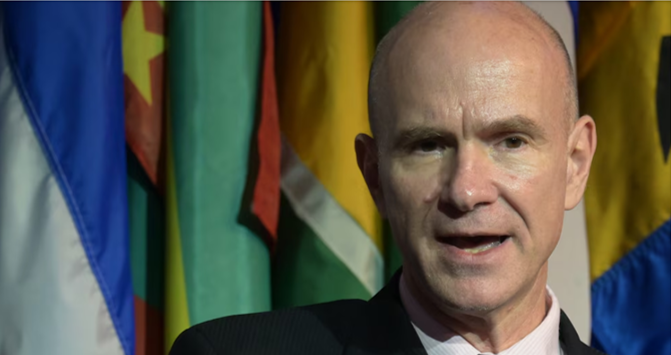
At the end of September 2026, I traveled to Mexico City to present at an event hosted by the Konrad Adenauer Foundation, Anahuac University, and the Institute for Strategy and Defense Research. While there, I also had the opportunity to visit several Mexican security institutions and consult with academic, business, and security sector colleagues in the city.
Thinking About “Middle Powers”
The theme of the conference, “Middle Powers” was appropriate for capturing the situation of Mexico, although perhaps not in the way the conference organizers intended. The event, in some ways, was shaped by the analytical current begun by Canadian Prime Minister Mark Carney and his impactful speech at the January 2026 World Economic Forum at Davos. There, he argued the need for “Middle Powers” such as Canada to work together in new and greater ways, in order to address challenges in the world order that have grown with the rise of the People’s Republic of China (PRC) and the significant shift in the posture of the United States toward alliances and global institutions.
The “Middle Powers” event was attended by an impressive array of European diplomats and politicians, as well as notable figures from Mexico, Canada, Latin America, and elsewhere. It was notably balanced, and not at all anti-U.S., radical left, or embracing extra-hemispheric authoritarian states in its tone.
The event, from the beginning, was unintentionally overshadowed by the statement of Mexico’s Foreign Minister Roberto Velasco, in a different forum just days before, in which he said that Mexico did not subscribe to the thinking behind calling itself a “Middle Power.” The statement was arguably a testament to the level of concern within the government of Claudia Sheinbaum in Mexico, to avoid any posture that could be interpreted in Washington as displaying adversarial intent.
Although the even focused on how changing global dynamics impact countries such as Mexico and explored opportunities to productively work more together (particularly with Europe), for me, it unintentionally highlighted an important, if ironic reality: Mexico may or may not be a “Middle Power,” but in the new geopolitics shaped powerfully by Washington and Beijing, it finds itself “in the middle.”
The Mexican government is working hard to accommodate the demands of its neighbor to the North with respect to security, trade and other matters, while simultaneously, often cautiously and quietly, working to diversify its partnerships and show resolve to domestic supporters. The Sheinbaum Administration is hoping those actions can be effective, even while low-key enough not to incur the wrath of the Trump administration.
Mexico’s Diplomatic Dilemmas
Participants at the event generally concurred that the Sheinbaum government is unlikely to follow the inspiration of Canadian Prime Minister Carney to actively collaborate with other countries to find “strategic autonomy” in a path between the U.S. and China. One senior participant suggested that Mexico during the AMLO and Sheinbaum Presidencies, had effectively abdicated its once strong and independent foreign policy activism. Others discussed how a victory by Flavio Bolsonaro in Brazil’s October 2026 Presidential Election could further isolate the Sheinbaum administration as the region’s last major left-leaning government in the region, although some suggested that with the complex relationship between Sheinbaum and Brazil’s current leftist President Luis Ignacio “Lula” da Silva, a change in Brazil might not be entirely bad for Sheinbaum. Still, one luminary at the event lamented that they had never seen Mexico so alone.
In security affairs, like foreign policy, the Sheinbaum administration also finds itself “in the middle.” Her Administration has taken a more aggressive stance against criminal groups than her predecessor Andres Manuel Lopez Obrador (AMLO), with homicides under Sheinbaum officially down over 53%, and kidnappings down 70% since 2019 (although many of my Mexican colleagues were skeptical about the numbers). Mexico has also achieved important victories against criminal groups, including the February 2026 takedown of Jalisco Nuevo Generacion (CJNG) cartel head Nemesio Rubén Oseguera Cervantes (“El Mencho”). Her government has extradited 178 criminals to the United States, including 92 through three mass transfers.
Despite such initiatives and cooperation with the U.S., Sheinbaum’s Administration has arguably been put in a difficult political position by U.S. extradition requests for the sitting governor of Sinaloa Ruben Rocha Moya and other key figures allied with AMLO (Sheinbaum’s political mentor and MORENA movement founder). Sheinbaum’s dilemma grew deeper when, following her refusal to extradite Rocha Moya, he resumed his post and sought for a time to continue as Governor of Sinaloa. Sheinbaum’s position was even further complicated by the U.S. government’s revocation of the visa of AMLO’s son Andy over credible concerns over corruption and criminal ties. Sheinbaum must navigate between cooperating with the U.S. on its core priority of combatting criminal and terrorist groups in Mexico, versus accommodating her political mentor and the radical wing of the MORENA party, in which many already believe she has ceded too much Mexican sovereignty and dignity in accommodating the Trump Administration.
Finally, Mexico also continues to be “in the middle” in commercial dealings with the U.S and the PRC. Not only do 83% of Mexican exports go to the U.S., but Mexico is deeply integrated into the U.S. and broader North American economy through its supply chains. For the Sheinbaum Administration, preserving that access to and integration with the U.S., including reaching an agreement with Washington on renewing the U.S.-Mexico Canada Trade Agreement (USMCA), is arguably a national priority. That prioritization helps to explain the Sheinbaum Administration’s January 2026 imposition of tariffs of up to 50% on select imports from countries not having a trade agreement with Mexico as an effort to accommodate a key concern of Washington, that Mexico not allow Chinese companies to use the country to access the U.S. market.
Although Sheinbaum is working to accommodate the Trump Administration on the PRC, it is difficult for Mexico to halt trade with and investment from China entirely. PRC-based companies have an important presence in Mexico particularly in the ports, telecommunications, automotive, assembly and distribution sectors, among others. Between 2020 and 2025 alone, PRC-based companies invested an estimated $11.6 billion in the country, although that investment fell off dramatically with uncertainty over the renewal of USMCA. Shortly before my visit, a Chinese consortium announced a major, $930 million investment in a complex in Tapachula, in the south of Mexico, for building electric vehicles, auto parts and other items.
For Mexico, the PRC compliments other Asian countries including Japan, South Korea and India, as well as the European Union, as an alternative market and source of investment. Preserving that option becomes particularly important for Mexico in the unlikely but enormously damaging event that USMCA is allowed to expire at the end of the 10-year period that started July 1, 2026, with the Trump Administration announcement it would not renew the treaty.
Beyond commerce, the Chinese have also maintained a small, but significant presence in military institutions in the region, including at least two students in Mexico’s Naval War College (CESNAV), one in its Army War College, and one in its National Defense College (CODENAL). They have also long courted Mexico’s space program, although I was told during the present visit that the PRC has made little headway, largely because the program has been so poorly funded by the current government and its predecessor.
Such activities, while arguably providing only minor benefits to the Mexican military and other institutions, arguably allow the Sheinbaum Administration to assert her government’s diversity of relations, particularly to those in MORENA and the population who see her government acting in too much of a subordinate fashion to the United States.
Conclusion
I left Mexico deeply impacted by the good and thoughtful interactions I had with colleagues and friends at the Middle Powers event, and at the Mexican Army and Navy institutions that also hosted me for conversations during my time in the country. I left reinforced in my conviction of the importance of U.S.-Mexico cooperation to the security and prosperity of both of our nations.
In Mexico, the Sheinbaum government continues to embrace the U.S. rather than leverage its other relationships to build “strategic autonomy.” Still, the conversations during the important Middle Powers event for me was a reminder that the significant change in U.S. rhetoric and actions regarding alliances, international institutions, and other matters, is driving regrettable and sometimes worrisome changes in assumptions and behaviors of a myriad of partners. Those changes could, in the long-term, gravely damage the U.S. strategic position and its fundamental national interests.
With our Mexican neighbors, as with other U.S. friends, allies and partners, it is more important than ever to act in ways that build confidence and nurture the relationships on which U.S. security and prosperity depends.